
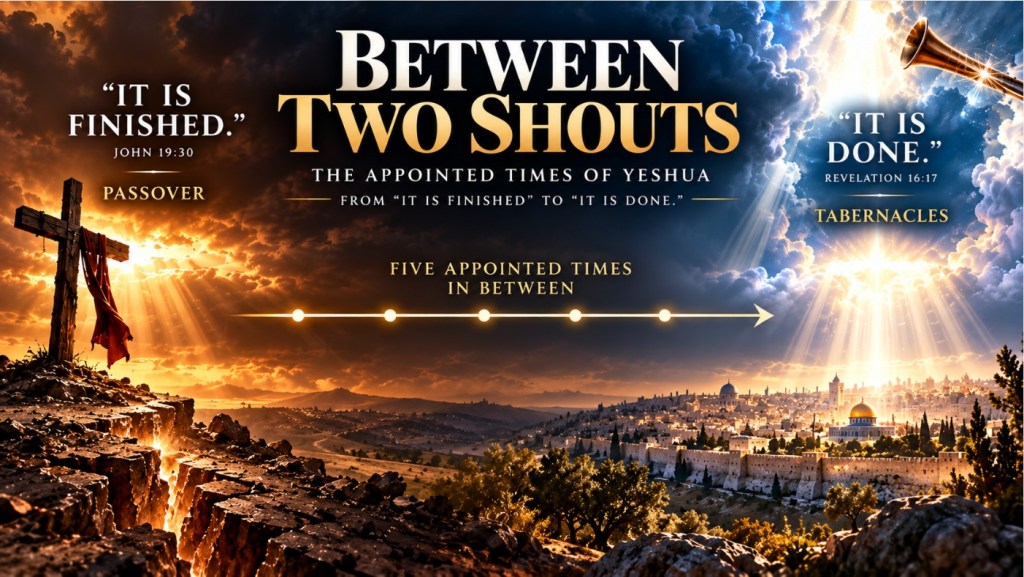
“It Is BETWEEN TWO SHOUTS
“It Is Finished,” “Yet Once More,” and “It Is Done”
When most of us hear the word feast, we think of food, celebration, and a large meal.
But the biblical idea behind the feasts of the LORD is much deeper. These are God’s appointed times—specific times established by Him for His purposes.
Leviticus makes something clear from the beginning:
“Concerning the feasts of the LORD, which ye shall proclaim to be holy convocations, even these are my feasts.”
— Leviticus 23:2
My feasts.
His appointed times.
And I believe these appointed times reveal a prophetic story that stretches between two great shouts.
The first came from the cross:
“IT IS FINISHED.”
The last comes from the throne:
“IT IS DONE.”
And standing between those two declarations is an extraordinary promise:
“YET ONCE MORE.”
The first shout was followed by an earthquake.
The final declaration is followed by an earthquake.
The first accomplished the price of redemption.
The last announces the completion of God’s judgment as the Kingdom draws near.
Could Hebrews 12 be showing us the connection?
THE FIRST APPOINTED TIME
Passover stands at the beginning of the annual appointed times.
And it was at Passover that Yeshua gave His life.
John records His declaration from the cross:
“When Jesus therefore had received the vinegar, he said, It is finished: and he bowed his head, and gave up the ghost.”
— John 19:30
Matthew gives us another detail.
Yeshua did not simply whisper His final words.
Matthew says:
“Jesus, when he had cried again with a loud voice, yielded up the ghost.”
— Matthew 27:50
Then something happened immediately afterward:
“And, behold, the veil of the temple was rent in twain from the top to the bottom; and the earth did quake, and the rocks rent.”
— Matthew 27:51
His voice.
Then the earth shook.
But it did not stop there.
“And the graves were opened; and many bodies of the saints which slept arose,
And came out of the graves after his resurrection, and went into the holy city, and appeared unto many.”
— Matthew 27:52–53
Look at the order:
A LOUD VOICE
↓
THE EARTH QUAKES
↓
THE GRAVES ARE OPENED
↓
SAINTS ARE RESURRECTED
↓
THEY ENTER THE HOLY CITY
These were historical events.
But I believe they were also a prophetic shadow of something much greater still to come.
THE LAW AND THE SHAKING OF SINAI
This brings us to Hebrews 12.
The chapter first takes us back to Mount Sinai.
There was fire.
There was darkness.
There was a trumpet.
There was the voice of God.
And there was fear.
Exodus tells us:
“And mount Sinai was altogether on a smoke… and the whole mount quaked greatly.”
— Exodus 19:18
So when we later read Hebrews 12:26, it is understandable that our minds immediately go back to Sinai:
“Whose voice then shook the earth: but now he hath promised, saying, Yet once more I shake not the earth only, but also heaven.”
— Hebrews 12:26
Sinai appears to be the obvious fulfillment.
God spoke.
There was a shaking.
But look more closely.
Exodus specifically tells us:
“The whole MOUNT quaked greatly.”
Hebrews says:
“Whose voice then shook the EARTH.”
That distinction alone does not prove that Hebrews is referring to the crucifixion.
But it should cause us to look more carefully at where Hebrews 12 is taking us.
Because the chapter does not leave us standing at Sinai.
SINAI SHOWED US THE PROBLEM
Sinai gave Israel the Law.
And the Law was holy, just, and good.
The problem was never God’s Law.
The problem was us.
The commandments revealed God’s righteous standard, but in doing so they exposed humanity’s sin.
Paul writes:
“For by the law is the knowledge of sin.”
— Romans 3:20
Sinai showed us what righteousness required.
But it also showed us that sinful humanity could not achieve righteousness through perfect obedience to the Law.
The Law exposed the debt.
But someone still had to pay it.
And this is precisely where Hebrews 12 begins moving us.
It takes us away from Sinai and brings us somewhere else.
“BUT YE ARE COME UNTO MOUNT SION”
Hebrews says:
“But ye are come unto mount Sion, and unto the city of the living God, the heavenly Jerusalem…”
— Hebrews 12:22
Then:
“And to Jesus the mediator of the new covenant, and to the blood of sprinkling…”
— Hebrews 12:24
Notice the movement.
Sinai.
Then:
Mount Sion.
The heavenly Jerusalem.
Jesus.
The New Covenant.
The blood.
And only two verses later:
“Whose voice then shook the earth…”
This is why I believe we should at least ask whether Hebrews is pointing us toward something greater than the mountain shaking at Sinai.
Sinai gave us the Law.
But Calvary paid the penalty for breaking it.
WHOSE VOICE SHOOK THE EARTH?
Now return to Matthew.
“Jesus, when he had cried again with a loud voice, yielded up the ghost.”
— Matthew 27:50
Then:
“And… the earth did quake…”
— Matthew 27:51
Whose voice had just sounded?
Yeshua’s.
What happened?
The earth quaked.
And what had Yeshua declared?
“IT IS FINISHED.”
Now read Hebrews again:
“Whose voice then shook the earth: but now he hath promised, saying, Yet once more I shake not the earth only, but also heaven.”
— Hebrews 12:26
I believe there is a profound possibility here.
Sinai appears at first to provide the answer.
But Sinai says the mountain quaked.
At Calvary, after Yeshua’s loud cry, Matthew specifically tells us:
“THE EARTH DID QUAKE.”
And Hebrews has just brought us to:
Jesus.
The New Covenant.
His blood.
Then it speaks of the voice that “shook the earth.”
Perhaps we have been looking backward only as far as Sinai when Hebrews is inviting us to see what Sinai ultimately pointed toward.
THE LAW ESTABLISHED THE DEBT
At Sinai, God’s standard was revealed.
At Calvary, the price for violating that standard was paid.
Paul writes:
“Christ hath redeemed us from the curse of the law, being made a curse for us…”
— Galatians 3:13
That makes Yeshua’s declaration from the cross even more powerful:
“IT IS FINISHED.”
The Law had exposed sin.
The debt existed.
The penalty remained.
But the spotless Lamb took that penalty upon Himself.
Then He cried with a loud voice:
“IT IS FINISHED.”
And:
THE EARTH SHOOK.
Sinai showed mankind the debt.
Calvary paid it.
And then Hebrews tells us something remains:
“YET ONCE MORE.”
WHAT DOES “YET ONCE MORE” POINT TO?
This is where the pattern becomes extraordinary.
Hebrews does not merely say there was a shaking in the past.
It tells us another one is coming:
“Yet once more I shake not the earth only, but also heaven.”
— Hebrews 12:26
Yet once more.
If Hebrews is pointing backward to a voice that shook the earth, then what is the future shaking?
Where in Scripture do we find another great voice followed by another great earthquake?
Revelation gives us a remarkable answer.
THE LAST GREAT DECLARATION
Revelation 16 says:
“And the seventh angel poured out his vial into the air; and there came a great voice out of the temple of heaven, from the throne, saying, It is done.”
— Revelation 16:17
A great voice.
From heaven.
From the throne.
And the declaration:
“IT IS DONE.”
Then the very next verse says:
“And there were voices, and thunders, and lightnings; and there was a great earthquake, such as was not since men were upon the earth…”
— Revelation 16:18
Look at the parallel.
At Calvary:
“IT IS FINISHED.”
LOUD VOICE
↓
THE EARTH QUAKES
At the culmination in Revelation:
“IT IS DONE.”
GREAT VOICE FROM HEAVEN
↓
GREAT EARTHQUAKE
And between them Hebrews says:
“YET ONCE MORE.”
That is why I believe the future “once more” finds its fulfillment in the events surrounding:
“IT IS DONE.”
And if “yet once more” points forward to the great declaration “It is done,” followed by the great earthquake, then we should seriously consider whether the former voice that “shook the earth” points us back to the declaration:
“IT IS FINISHED.”
The symmetry is difficult to ignore.
TWO DECLARATIONS
The words themselves are remarkably similar.
At the cross:
IT IS FINISHED.
From the throne:
IT IS DONE.
One announces completion.
The other announces completion.
One is followed by the earth shaking.
The other is followed by the greatest earthquake described in Revelation.
And Hebrews stands between them saying:
“YET ONCE MORE.”
That gives us an extraordinary prophetic progression:
THE FIRST SHOUT
“IT IS FINISHED.”
The earth shakes.
Then:
THE PROMISE
“YET ONCE MORE.”
Not earth only—
but heaven also.
Then:
THE FINAL SHOUT
“IT IS DONE.”
The great earthquake follows.
THE FIRST SHAKING ALSO BROUGHT RESURRECTION
But there is another reason the first shaking matters.
Return to Matthew 27.
After Yeshua’s loud cry and the earthquake:
“And the graves were opened…”
— Matthew 27:52
Then saints arose.
And where did they go?
“…and went into the holy city…”
— Matthew 27:53
So the pattern becomes:
VOICE
EARTHQUAKE
OPENED GRAVES
RESURRECTION
HOLY CITY
Could this have been a small prophetic picture of the greater events that will eventually accompany the completion of God’s plan?
Because the end of the biblical story contains these same themes.
A great voice.
A great shaking.
Resurrection.
The gathering of God’s people.
And ultimately:
The Holy City.
FROM THE HOLY CITY TO NEW JERUSALEM
Revelation eventually tells us:
“And I John saw the holy city, new Jerusalem, coming down from God out of heaven…”
— Revelation 21:2
Then:
“Behold, the tabernacle of God is with men, and he will dwell with them…”
— Revelation 21:3
At Calvary, resurrected saints entered the holy city.
At the ultimate completion of God’s plan, His redeemed people dwell with Him in the Holy City—New Jerusalem.
I do not believe that similarity should simply be ignored.
The first may be showing us the pattern.
The last reveals its fullness.
FROM PASSOVER TO TABERNACLES
And now the appointed times begin to come into focus.
At one end stands Passover.
At the other stands Tabernacles.
Passover points to sacrifice.
Tabernacles points to dwelling.
Passover gives us the Lamb.
Tabernacles ultimately gives us God dwelling with His people.
At Passover, Yeshua declares:
“IT IS FINISHED.”
And Revelation eventually brings us to:
“IT IS DONE.”
Could the appointed times between them be telling one continuous prophetic story?
I believe they are.
“MINE HOUR IS NOT YET COME”
There is another fascinating clue in John’s Gospel.
At the wedding at Cana, Mary tells Yeshua that the wine has run out.
Yeshua answers:
“Woman, what have I to do with thee? mine hour is not yet come.”
— John 2:4
He then turns water into wine.
Soon afterward John tells us:
“And the Jews’ passover was at hand…”
— John 2:13
John does not explicitly tell us that the wedding itself occurred at Passover, so we should not make the chronology say more than Scripture says.
But the theme of Yeshua’s hour continues throughout John.
Eventually:
“The hour is come, that the Son of man should be glorified.”
— John 12:23
Then:
“Now before the feast of the passover, when Jesus knew that his hour was come…”
— John 13:1
At Cana:
“MINE HOUR IS NOT YET COME.”
At His final Passover:
HIS HOUR WAS COME.
Then the blood was poured out.
And the declaration came:
“IT IS FINISHED.”
“SHOW THYSELF TO THE WORLD”
Now look at the other end of the appointed times.
John writes:
“Now the Jews’ feast of tabernacles was at hand.”
— John 7:2
Yeshua’s brothers challenge Him:
“If thou do these things, shew thyself to the world.”
— John 7:4
What an extraordinary statement.
SHOW YOURSELF TO THE WORLD.
Yeshua answers:
“My time is not yet come…”
— John 7:6
He later goes to the feast, but John specifically tells us:
“…then went he also up unto the feast, not openly, but as it were in secret.”
— John 7:10
Notice the contrast.
His brothers:
SHOW YOURSELF TO THE WORLD.
Yeshua:
MY TIME IS NOT YET.
Then He goes:
NOT OPENLY.
I believe that exchange points prophetically toward another appointed time when He truly will show Himself to the world.
And this time it will not be in secret.
IMMEDIATELY AFTER THE TRIBULATION
Yeshua describes that day:
“Immediately after the tribulation of those days shall the sun be darkened… and the powers of the heavens shall be shaken.”
— Matthew 24:29
Heaven itself is shaken.
Then:
“And then shall appear the sign of the Son of man in heaven… and they shall see the Son of man coming in the clouds of heaven with power and great glory.”
— Matthew 24:30
And:
“And he shall send his angels with a great sound of a trumpet, and they shall gather together his elect…”
— Matthew 24:31
Now Hebrews’ language becomes even more striking:
“Yet once more I shake not the earth only, but also heaven.”
Yeshua said that immediately after the Tribulation:
“the powers of the heavens shall be shaken.”
Then He appears openly.
His brothers once said:
“Show thyself to the world.”
At Tabernacles His answer was:
Not yet.
But His appointed time will come.
THE FALL APPOINTED TIMES
I believe the fall appointed times reveal the order surrounding that glorious appearing.
First:
Trumpets.
Then the ten days traditionally called the Days of Awe.
Then:
The Day of Atonement.
Then:
Tabernacles.
Trumpets.
Atonement.
Tabernacles.
A great sound.
Reconciliation.
Dwelling.
And ultimately:
“Behold, the tabernacle of God is with men…”
— Revelation 21:3
The appointed times move from the sacrifice of the Lamb toward God dwelling with His people.
From Passover to Tabernacles.
From the cross to the Kingdom.
A KINGDOM THAT CANNOT BE SHAKEN
And this is where Hebrews brings everything together.
After saying:
“Yet once more…”
Hebrews explains:
“And this word, Yet once more, signifieth the removing of those things that are shaken… that those things which cannot be shaken may remain.”
— Hebrews 12:27
Then:
“Wherefore we receiving a kingdom which cannot be moved…”
— Hebrews 12:28
That is the destination.
The Kingdom.
Sinai revealed the Law.
The Law revealed sin.
Calvary paid the penalty.
Yeshua cried:
“IT IS FINISHED.”
And the earth shook.
Hebrews then tells us:
“YET ONCE MORE.”
One more shaking.
Not earth only.
Heaven also.
And Revelation gives us the great voice from the throne:
“IT IS DONE.”
Followed by the great earthquake.
Then what remains?
A Kingdom which cannot be shaken.
BETWEEN TWO SHOUTS
Now the entire picture can be seen together.
At Sinai:
The Law was given.
The mountain shook.
The Law revealed the standard we could not perfectly keep.
Then came the One who fulfilled what we could not.
At Passover, the Lamb gave His life.
He cried with a loud voice:
“IT IS FINISHED.”
And:
“THE EARTH DID QUAKE.”
Graves opened.
Saints arose.
They entered the holy city.
Then Hebrews gives us the promise:
“YET ONCE MORE.”
Not merely the earth.
Heaven also.
And at the culmination, a great voice comes from heaven, from the throne:
“IT IS DONE.”
Then comes the great earthquake.
What can be shaken is removed.
What cannot be shaken remains.
The Kingdom comes into view.
The saints ultimately inherit the Holy City.
And God dwells with His people.
Perhaps that is the deeper meaning hidden within the appointed times.
They stand between two great declarations.
The first from the cross:
“IT IS FINISHED.”
The last from the throne:
“IT IS DONE.”
And between those two shouts stands the promise:
“YET ONCE MORE.”
If the future shaking is connected to the voice declaring “It is done,” then perhaps the former shaking deserves another look.
Because immediately after Yeshua cried with a loud voice—
the earth shook.
The Law had shown us the debt.
The Lamb had paid it.
The first appointed fulfillment was complete.
And from Passover to Tabernacles, from the Lamb to the King, from the cross to the Kingdom, God’s appointed times continue moving toward the day when the final voice declares:
“IT IS DONE.”

