
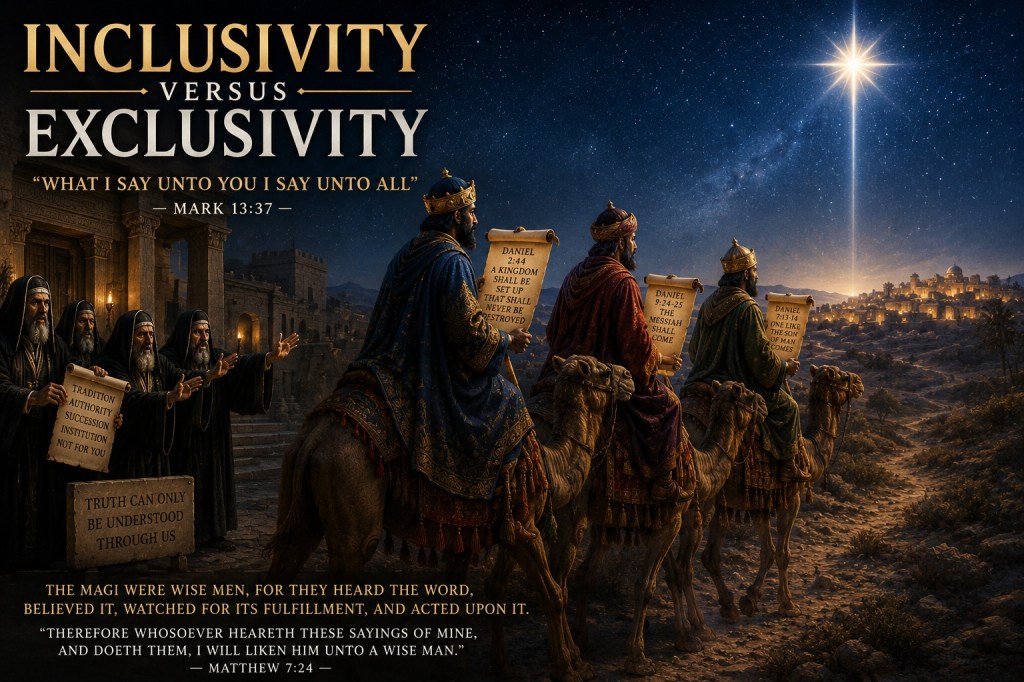
“What I Say Unto You I Say Unto All”
One of the great questions within Christianity is this:
Did Christ open the knowledge of God to all believers through the Holy Spirit and the Scriptures, or is true understanding ultimately dependent upon an exclusive institutional succession?
Many today are taught that Scripture by itself becomes merely “private interpretation” unless filtered through an authorized church structure. Yet when we carefully examine the Scriptures themselves, we find a very different pattern emerging — one that repeatedly points believers back to Christ, the Holy Spirit, and the written Word of God.
Perhaps no example reveals this more clearly than the Magi.
The wise men who arrived seeking Christ were not priests in Jerusalem. They were not Levites. They were not members of the religious hierarchy. They were outsiders from the East, living centuries after the prophet Daniel had already died.
And yet, they recognized the arrival of the Messiah while many within the institutional religious structure failed to recognize Him.
Why?
Because they had the writings.
God revealed prophetic truth to Daniel. Daniel recorded those revelations. Long after Daniel’s death, the Magi were still reading what had been written. They watched. They discerned. They believed.
No council interpreted Daniel for them.
No priestly succession authenticated their understanding.
No religious hierarchy in Jerusalem authorized their conclusions.
They simply believed the prophetic Word enough to watch for its fulfillment.
And they found Christ.
It is striking that Scripture calls them wise men.
Christ Himself later defines a wise man this way:
“Therefore whosoever heareth these sayings of mine, and doeth them, I will liken him unto a wise man.”
— Matthew 7:24
The Magi heard the prophetic Word preserved through Daniel, believed it, watched faithfully, and acted upon it.
Their wisdom was not rooted in institutional position, but in hearing, believing, and responding to the revelation God had given.
This creates a serious tension with the idea that believers are fundamentally incapable of understanding God’s revelation apart from institutional authority.
The Magi stand as witnesses that God’s written revelation can be understood by those who seek Him in faith.
Ironically, while the outsiders recognized the Messiah, many of those possessing succession, tradition, position, and authority did not.
Jerusalem had the temple.
Jerusalem had the priesthood.
Jerusalem had the scribes.
Yet the outsiders arrived first.
This pattern appears repeatedly throughout Scripture.
The shepherds recognized Him.
Fishermen followed Him.
The Samaritan woman testified of Him.
A thief on a cross believed in Him.
Wise men from the East searched for Him.
Again and again, God reveals Himself not merely through institutional position, but through humility, faith, and spiritual hunger.
This is why the words of Christ become so important:
“And what I say unto you I say unto all, Watch.”
— Mark 13:37
Notice carefully what Jesus did not say.
He did not say:
“What I say unto you I say only unto your successors.”
He said:
“What I say unto you I say unto all.”
The command to watch was expanded outward beyond the apostles themselves. Christ placed responsibility upon all believers to remain spiritually awake and discerning.
This harmonizes perfectly with the words of John:
“But the anointing which ye have received of him abideth in you, and ye need not that any man teach you…”
— 1 John 2:27
John was not abolishing teachers entirely. Scripture itself speaks of pastors, elders, and teachers. But John was revealing something deeper: believers are not spiritually abandoned, dependent upon earthly institutions as the ultimate source of truth. The Holy Spirit Himself illuminates the Word of God.
This is why the Bereans were praised in Acts 17:11.
They searched the Scriptures daily to test whether even the teachings of Paul were true.
Notice the implications carefully:
Paul was an apostle.
Yet believers were still commended for examining the Scriptures themselves.
They were not condemned for “private interpretation.”
They were praised for testing all things against the written Word.
Even Peter acknowledged that Paul’s writings contained difficult things which unstable men could distort:
“…in which are some things hard to be understood, which they that are unlearned and unstable wrest…”
— 2 Peter 3:16
But Peter did not conclude:
“Therefore believers must never read these writings for themselves.”
The warning only exists because believers were expected to read them.
The biblical model is not blind dependence upon men.
The biblical model is:
read,
watch,
discern,
test,
and remain led by the Spirit of God.
This becomes even clearer in the book of Hebrews.
Under the old covenant, access to God flowed through earthly priesthood. But Hebrews teaches that Christ Himself became our eternal High Priest.
The veil was torn.
Access was opened.
“For there is one God, and one mediator between God and men, the man Christ Jesus.”
— 1 Timothy 2:5
Christ is now the mediator.
Christ is the High Priest.
Christ opens understanding.
Christ sends the Holy Spirit.
Believers are invited to come boldly before the throne through Him directly.
This does not eliminate fellowship, teachers, or church community. But it does challenge the idea that institutional lineage itself becomes the necessary gatekeeper of truth.
Scripture repeatedly warns believers not to place ultimate confidence in man:
“Put not your trust in princes, nor in man…”
— Psalm 146:3
“Cursed be the man that trusteth in man…”
— Jeremiah 17:5
The danger begins when believers slowly shift their dependence from Christ and the Spirit toward institutional certainty rooted primarily in men and succession.
Ironically, even many of the early writers highly respected within Eastern Orthodoxy strongly encouraged ordinary believers to engage the Scriptures personally.
John Chrysostom repeatedly urged believers to read Scripture daily and taught that the Scriptures were not given only to monks or clergy, but to all people alike. He warned that ignorance of Scripture was one of the great causes of spiritual destruction.
Irenaeus argued against secretive elite knowledge and emphasized that God’s truth had been openly proclaimed.
Origen emphasized the necessity of spiritual illumination in understanding Scripture.
Even Augustine stated that ultimate authority belonged to the canonical Scriptures themselves.
None of these men rejected fellowship or teachers. But neither did they teach that believers were incapable of recognizing truth through the Word and Spirit of God.
The Scriptures consistently point believers back to Christ Himself.
Not the revelation of an institution.
Not the revelation of a succession line.
“The Revelation of Jesus Christ.”
— Revelation 1:1
That title alone says much more than many realize.
The same God who revealed truth to Daniel revealed it to the Magi through the written Word.
The same Christ who spoke to the apostles said, “I say unto all.”
The same Spirit who inspired the Scriptures still leads believers into truth today.
Daniel wrote.
The Magi read.
God revealed.
And they found Christ.
Jerusalem had succession.
The Magi had faith.
Jerusalem had authority.
The Magi watched.
Jerusalem had scholars.
The Magi followed the Word God had already spoken.
And the outsiders arrived first.
The question every believer must ask is this:
If the Magi could watch through the writings of Daniel, why would Christ’s followers today be discouraged from doing the same?

