
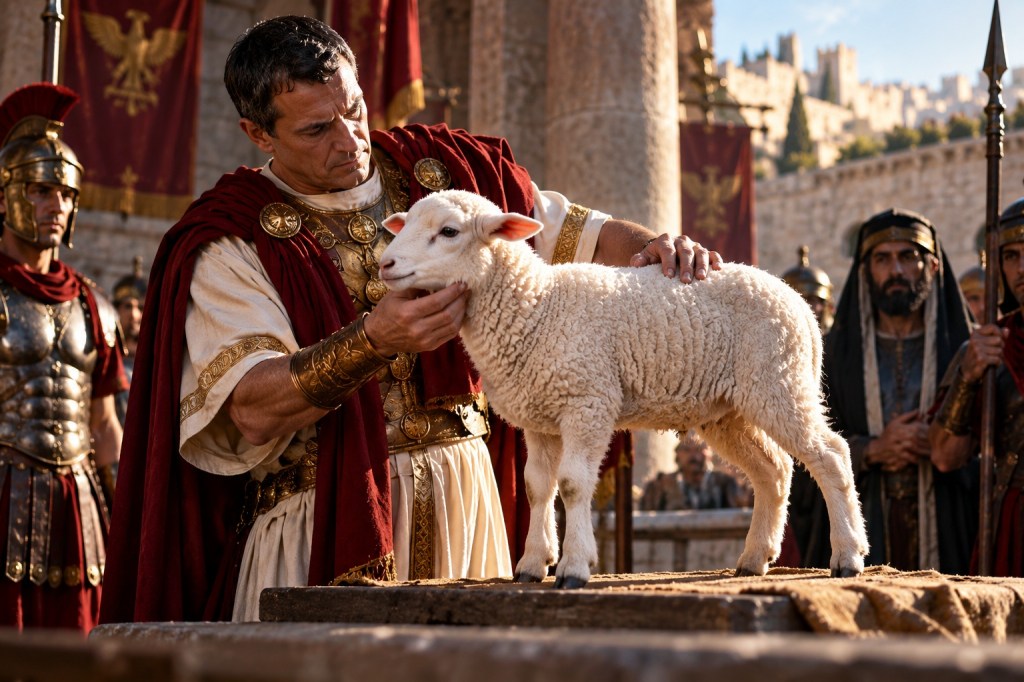
The Examination of the Passover Lamb
Sometimes a person can speak words far greater than they understand.
Pontius Pilate may have done exactly that.
Yeshua stood before the Roman governor during Passover, accused and awaiting judgment. After questioning Him, Pilate returned to the people and made a remarkable declaration:
“I find in him no fault at all.”
— John 18:38
On the surface, this was a legal verdict. Pilate was saying that he found no basis in the accusations before him to condemn Yeshua.
But this was Passover.
And once we look at Pilate’s words through the pattern established in Exodus, something much deeper comes into view.
The Passover Lamb was being examined.
A LAMB WITHOUT BLEMISH
When God established the first Passover in Egypt, He gave Israel specific instructions concerning the lamb:
“Your lamb shall be without blemish, a male of the first year…”
— Exodus 12:5
The sacrifice could not be defective.
The lamb had to be acceptable before its blood could be shed.
That requirement becomes important when we come to the Gospel of John, because John identifies Yeshua from the very beginning:
“Behold the Lamb of God, which taketh away the sin of the world.”
— John 1:29
John introduces Him as the Lamb.
Then, as His ministry reaches its appointed conclusion, John brings that Lamb to Passover.
And before He is sacrificed, He is examined.
PILATE’S EXAMINATION
Yeshua is brought before Pilate.
Accusations are made.
Pilate questions Him.
Then the governor returns with his conclusion:
“I find in him no fault at all.”
— John 18:38
Later Pilate brings Him out again:
“Behold, I bring him forth to you, that ye may know that I find no fault in him.”
— John 19:4
And when the demand for crucifixion continues, Pilate says it a third time:
“Take ye him, and crucify him: for I find no fault in him.”
— John 19:6
Three examinations.
Three declarations.
And the verdict never changes:
JOHN 18:38
“I FIND IN HIM NO FAULT AT ALL.”
JOHN 19:4
“I FIND NO FAULT IN HIM.”
JOHN 19:6
“I FIND NO FAULT IN HIM.”
The Lamb had been examined.
Pilate was not a priest inspecting a sacrificial animal. He was a Roman governor examining an accused man. Yet without realizing the prophetic significance of his own words, he repeatedly gave a verdict that perfectly fits the requirement established at the first Passover:
The sacrifice was without blemish.
Peter later describes Yeshua in unmistakably Passover language:
“But with the precious blood of Christ, as of a lamb without blemish and without spot.”
— 1 Peter 1:19
Pilate could only determine that he found no fault concerning the accusations placed before him.
But Scripture reveals the greater truth:
Yeshua was not merely innocent of those accusations.
He was without sin.
“…in all points tempted like as we are, yet without sin.”
— Hebrews 4:15
The earthly examination reflected a heavenly reality.
The Lamb was without blemish.
THE GUILTY MAN GOES FREE
Then John gives us another extraordinary Passover picture.
Pilate reminds the crowd:
“But ye have a custom, that I should release unto you one at the passover…”
— John 18:39
The choice comes down to Yeshua and Barabbas.
One has just been declared without fault.
The other is a condemned prisoner.
The people choose Barabbas.
“Then cried they all again, saying, Not this man, but Barabbas.”
— John 18:40
The result is striking:
The guilty man is released.
The innocent One goes toward death.
Barabbas walks away.
Yeshua goes toward the cross.
That exchange captures the heart of substitution.
The innocent takes the place of the guilty.
And suddenly Barabbas becomes more than simply another character in the story.
He becomes a picture of us.
We are the ones who deserved judgment.
Yet the Lamb took our place.
“WHEN I SEE THE BLOOD”
At the first Passover, possessing a lamb was not enough.
The lamb had to die.
Its blood had to be applied.
God said:
“And the blood shall be to you for a token upon the houses where ye are: and when I see the blood, I will pass over you…”
— Exodus 12:13
The pattern was established:
A lamb without blemish.
The death of the lamb.
The blood applied.
Deliverance from judgment.
Centuries later, Paul tells us exactly where that pattern was leading:
“For even Christ our passover is sacrificed for us.”
— 1 Corinthians 5:7
The Passover lamb in Egypt was the shadow.
Yeshua was the fulfillment.
NOT ONE BONE BROKEN
There is another detail John specifically wants us to notice.
God had commanded concerning the original Passover lamb:
“Neither shall ye break a bone thereof.”
— Exodus 12:46
At the crucifixion, the soldiers broke the legs of the two men crucified beside Yeshua.
But when they reached Him, He was already dead.
“But when they came to Jesus, and saw that he was dead already, they brake not his legs.”
— John 19:33
John then explains:
“For these things were done, that the scripture should be fulfilled, A bone of him shall not be broken.”
— John 19:36
This was not an insignificant detail.
The Lamb introduced at the beginning of John’s Gospel has reached Passover.
His blood has been shed.
Yet His bones remain unbroken.
The ancient pattern is being fulfilled before their eyes.
“IT IS FINISHED”
Finally, Yeshua makes His declaration:
“When Jesus therefore had received the vinegar, he said, It is finished: and he bowed his head, and gave up the ghost.”
— John 19:30
Now step back and look at what has happened.
God required:
A lamb without blemish.
John announced:
“Behold the Lamb of God.”
Pilate examined Him:
FIRST DECLARATION:
“I FIND IN HIM NO FAULT AT ALL.”
SECOND DECLARATION:
“I FIND NO FAULT IN HIM.”
THIRD DECLARATION:
“I FIND NO FAULT IN HIM.”
Then the guilty man was released.
The innocent Lamb went to His death.
His blood was shed.
His bones remained unbroken.
And finally:
“IT IS FINISHED.”
What began centuries earlier in Egypt had reached its greater fulfillment.
The blood on the doorposts was pointing forward.
The lamb without blemish was pointing forward.
The deliverance from judgment was pointing forward.
Passover itself was pointing forward.
It was pointing toward Yeshua.
And perhaps one of the most extraordinary parts of the story is that the man who officially examined Him did not understand the full prophetic significance of the verdict he was giving.
Pilate thought he was rendering the judgment of Rome.
But his words fit the requirement God had established for Passover generations earlier:
“I FIND IN HIM NO FAULT AT ALL.”
The Lamb had been examined.
The Lamb was without blemish.
The appointed hour had come.
And Christ our Passover was sacrificed for us.

