
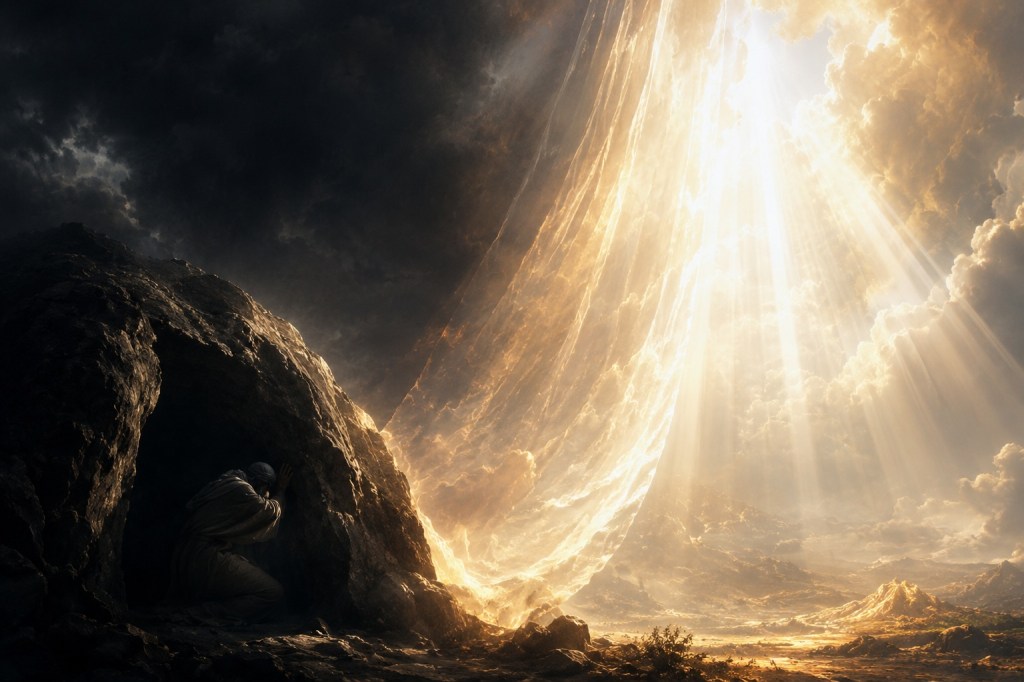
When Jesus cried from the cross,
“My God, my God, why hast thou forsaken me?”
— The Gospel of Matthew
many have assumed this was the moment the Father turned away because Jesus had become sin.
But does Scripture actually say that?
Or have we inherited an assumption that deserves to be examined more carefully?
The common teaching is that God could not look upon Jesus because He was bearing sin. Yet Scripture never explicitly says the Father could not look at the Son.
In fact, the Bible never says God is incapable of looking upon sin.
In Book of Job, Satan himself appeared before the Lord among the sons of God.
The issue in Scripture is not God looking upon sinful beings.
The issue is sinful flesh beholding the unveiled glory of God.
That is the direction of the warning.
When Moses asked to see God’s glory, the Lord said:
“Thou canst not see my face: for there shall no man see me, and live.”
— Book of Exodus
Notice carefully what God said.
He did not say, “I cannot look upon you.”
He said, “You cannot look upon Me and live.”
So God hid Moses in the cleft of the rock and covered him while His glory passed by.
That was not rejection.
That was protection.
Even Stephen, when heaven opened before him during his martyrdom, did not describe seeing the unveiled fullness of the Father. Instead, he said:
“Behold, I see the heavens opened, and the Son of man standing on the right hand of God.”
— Acts of the Apostles
But Jesus was different.
There had never been a veil between the Father and the Son.
Jesus was the spotless Lamb of God. He had always lived in perfect communion with the Father. There was no separation caused by sin because He knew no sin.
Until the cross.
Scripture says:
“For he hath made him to be sin for us, who knew no sin…”
— Second Epistle to the Corinthians
The Holy One became the sacrifice.
The Lamb bore the sin of the world.
And perhaps this is what happened in that dark hour upon the cross.
Not rejection.
Protection.
The Father did not turn away because He despised the Son becoming sin.
This was not sinful rebellion.
This was the greatest act of obedience and love the world would ever witness.
The sacrifice of Christ was pleasing to the Father because the Son was laying down His life willingly for the redemption of mankind.
Jesus Himself said:
“Therefore doth my Father love me, because I lay down my life…”
— The Gospel of John
So why the darkness?
Why the cry?
Why did it appear heaven had veiled itself?
Perhaps because the Son who had always beheld the Father openly was now standing in mortal flesh bearing the full weight of sin, and the unveiled glory of God is consuming to sinful flesh.
The Father may not have veiled Himself because He could not look upon the Son…
But because He did not want the fullness of His glory to consume the sacrifice before it was finished.
Jesus was appointed to die by crucifixion.
By nails.
By blood.
By thorns.
By the hands of sinful men.
Not by the unveiled consuming glory of the Father.
Moses was hidden from God’s glory so he would not die.
Christ may have been hidden from the Father’s unveiled glory so He could die.
One was protected from death.
The other was protected unto death.
And yet even in that darkness, Jesus did not speak in unbelief.
When He cried:
“My God, my God, why hast thou forsaken me?”
He was quoting Book of Psalms.
A Psalm that begins in suffering but ends in victory.
Because later in that same Psalm it says:
“For he hath not despised nor abhorred the affliction of the afflicted; neither hath he hid his face from him; but when he cried unto him, he heard.”
— Book of Psalms
Jesus knew the ending.
Even in suffering, He still said:
“My God.”
Faith remained.
Love remained.
Trust remained.
The cross was not the destruction of fellowship between the Father and the Son.
It was the preservation of the offering until redemption was complete.
And when the sacrifice was finished, the veil in the temple tore from top to bottom.
The One who had never known separation stepped behind our veil so mankind could finally enter the presence of God again.

