
“Upon This Rock I Will Build My Church”
Every structure begins with a foundation. When the foundation is correct, the building stands firm against storms, pressure, and time itself. But if the foundation is misplaced—even slightly—the structure may stand for a while before the cracks eventually appear.
For nearly two thousand years, one sentence spoken by Jesus Christ has shaped how millions understand the foundation of the church:
“And I say also unto thee, That thou art Peter, and upon this rock I will build my church; and the gates of hell shall not prevail against it.”
— Gospel of Matthew 16:18
At first glance the meaning may seem obvious. Yet when the passage is examined carefully, a question emerges that every believer must answer.
Which rock was Jesus pointing to?
The Confession Before the Rock
Before Jesus ever mentioned the rock, He asked His disciples a question that still echoes through history.
“Whom do you say that I am?”
It was Peter the Apostle who answered:
“You are the Christ, the Son of the living God.”
— Matthew 16:16
Jesus immediately responded that this truth was not discovered through human reasoning but revealed by the Father.
The rock-like truth had already been spoken:
Jesus is the Messiah.
Only after that confession does Jesus say:
“You are Peter, and upon this rock I will build my church.”
So the question becomes unavoidable.
Was Jesus building His church on the man who spoke, or on the truth that was revealed?
Two Rocks in One Sentence
Jesus first says:
“You are Peter.”
The name Peter means stone.
Then Jesus says:
“Upon this rock I will build my church.”
Two rocks appear in the same sentence:
• a disciple named Peter
• the revelation that Jesus is the Christ
Just five verses later something remarkable happens.
Peter rebukes Jesus for speaking about His coming death.
Jesus replies:
“Get behind me, Satan.”
— Matthew 16:23
The same disciple who had just spoken revelation now speaks from human reasoning.
Peter was passionate. Peter was faithful. Peter was chosen by Christ.
But Peter was still a man.
And Scripture repeatedly warns us about placing our ultimate confidence in men.
The Warning Scripture Repeats
The Bible consistently directs our trust away from human leaders and toward God alone.
“Put not your trust in princes, nor in the son of man, in whom there is no help.”
— Book of Psalms 146:3
The apostle Paul the Apostle later wrote:
“For no other foundation can anyone lay than that which is laid, which is Jesus Christ.”
— First Epistle to the Corinthians 3:11
There may be many stones in the building.
But there is only one foundation.
Peter Himself Points to the True Rock
If anyone had reason to elevate himself, it would have been Peter.
Yet when he later wrote to believers, he did not point to himself as the foundation of the church.
Instead he wrote:
“Behold, I lay in Zion a chief cornerstone, elect, precious.”
— First Epistle of Peter 2:6
Peter identifies Christ as the cornerstone.
Then he describes believers as living stones built upon Him.
Peter clearly understood something essential.
The church is not built on Peter.
The church is built on Christ.
Pentecost Did Not Change the Foundation
Some argue that Peter’s earlier failures happened before Pentecost and that afterward he became the foundation of the church.
But when Peter stands up in Acts of the Apostles 2, his message reveals something very different.
Peter does not elevate himself.
He proclaims Jesus.
“Jesus of Nazareth… you have crucified and slain.”
— Acts 2:22–23
Then he declares:
“This Jesus God has raised up.”
— Acts 2:32
And concludes:
“God has made that same Jesus… both Lord and Christ.”
— Acts 2:36
Peter calls people to repent:
“In the name of Jesus Christ.”
— Acts 2:38
Three thousand people believed that day because Peter pointed them to Christ, not to himself.
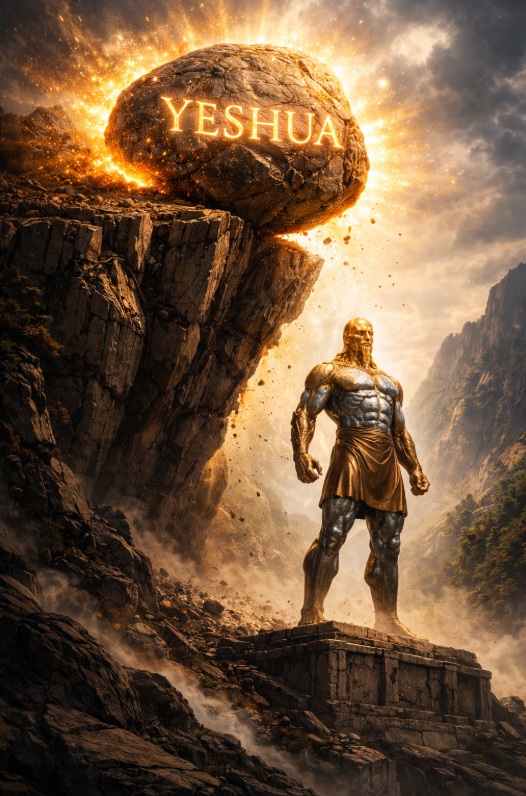
The Stone Cut Without Hands
Long before Jesus spoke of the rock of the church, Scripture had already revealed another stone.
In the vision interpreted by Daniel, King Nebuchadnezzar saw a great statue representing the kingdoms of man.
The statue had:
• a head of gold
• chest of silver
• body of bronze
• legs of iron
Then something dramatic happened.
“A stone was cut out without hands, which struck the image on its feet.”
— Book of Daniel 2:34
The statue representing human kingdoms collapsed.
Then the stone grew into a mountain filling the whole earth.
That stone represents the kingdom of Christ.
Human empires rise and fall.
Human systems crack and crumble.
But the stone cut without hands cannot be moved.
Why Every Church System Eventually Fails
History has shown something Scripture already told us.
Scandals and failures appear in every church system built by men.
Even in the earliest church recorded in Acts of the Apostles, deception appeared when Ananias and Sapphira lied before God.
Why?
Because Scripture is clear:
“For all have sinned and come short of the glory of God.”
— Epistle to the Romans 3:23
Human institutions can fail because humans fall short.
But there is one who never has.
The Only One Without Scandal
There has never been a scandal attached to Jesus Christ.
He fulfilled the Law and the Prophets.
He lived without sin.
“Who did no sin, neither was deceit found in his mouth.”
— First Epistle of Peter 2:22
He is the only foundation that cannot crack.
Christ Is More Than the Cornerstone
Scripture reveals something even greater.
Christ is not only the cornerstone.
He is the foundation.
He is the builder.
And ultimately He becomes the temple itself.
Jesus said:
“Destroy this temple, and in three days I will raise it up.”
— Gospel of John 2:19
The temple was no longer a structure made of stone.
The temple had become Christ Himself.
The Final Picture
The Bible ends with a breathtaking vision of New Jerusalem.
And in that city something astonishing appears—or rather does not appear.
“I saw no temple in it: for the Lord God Almighty and the Lamb are the temple of it.”
— Book of Revelation 21:22
No building.
No sanctuary.
No earthly structure.
Because everything rests on Him.
One Church, One Rock
Peter was a faithful apostle.
But the church was never meant to stand on Peter.
It stands on the One Peter confessed.
The Son of the living God.
And like the stone in Daniel’s vision, the rock of Christ will one day bring down every kingdom built by human hands.
Because when the dust settles and every statue of human authority has fallen, one rock will remain—
YESHUA, the cornerstone, the foundation, the builder, and the everlasting kingdom upon which the true church stands.
 asathief.com