
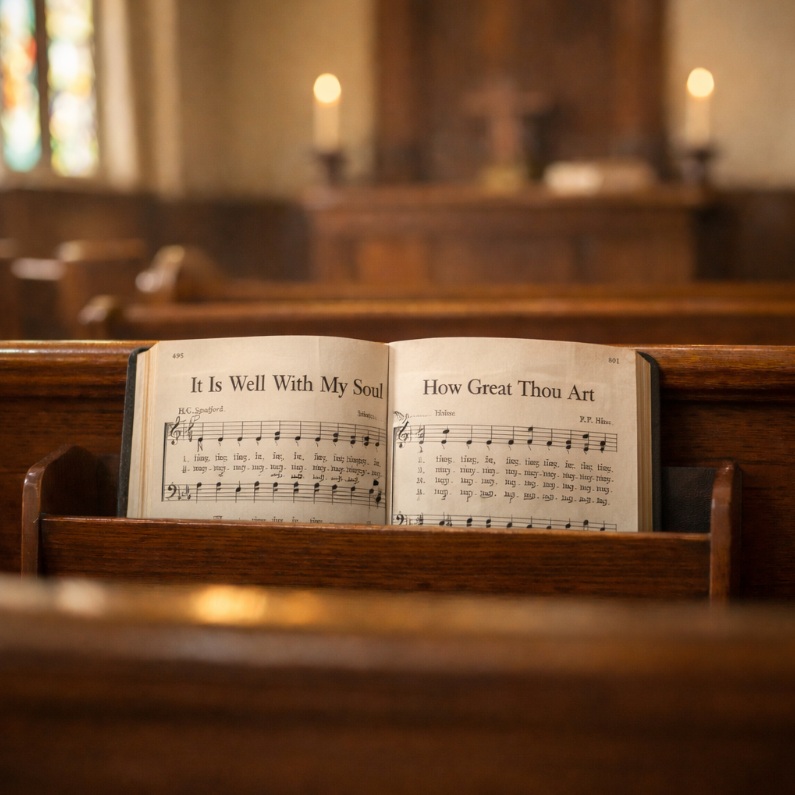
A Song Born From Tragedy, Faith, and Hope
You may have sung the hymn “It Is Well With My Soul.”
You may have heard it in church, in a movie, or during a difficult moment when someone needed comfort.
The words are simple, but they carry incredible weight:
Whatever my lot, Thou hast taught me to say,
It is well, it is well with my soul.
What many people do not realize is that this hymn was written in the middle of unimaginable tragedy. The story behind the song involves two men, two devastating disasters, and a faith that refused to give up hope.
Horatio G. Spafford — Faith in the Middle of Loss
Horatio Gates Spafford was a successful lawyer and businessman in Chicago in the late 1800s. He was also a committed Christian and a close friend of evangelist Dwight L. Moody, whose ministry was centered in Chicago.
But Spafford’s life was marked by painful loss.
In 1871, much of his real estate investment was destroyed in the Great Chicago Fire, a disaster that devastated the city and ruined many financially.
Just two years later, an even greater tragedy struck his family.
In 1873, Spafford planned a trip to Europe with his family. Business delays forced him to stay behind temporarily, so he sent his wife Anna and their four daughters ahead on the French ocean liner Ville du Havre.
While crossing the Atlantic Ocean, the ship collided with another vessel and sank in less than fifteen minutes.
Two hundred twenty-six people died.
Among them were all four of Spafford’s daughters.
Anna survived the disaster. When she finally reached land in Wales, she sent her husband a telegram containing just two heartbreaking words:
“Saved alone.”
Horatio immediately left Chicago to join her.
During his journey across the Atlantic, the ship’s captain informed him when they reached the approximate location where the Ville du Havre had gone down — the place where his daughters had died.
Standing over those waters, Horatio Spafford wrote the words that would become the hymn “It Is Well With My Soul.”
It was not written in comfort.
It was written in grief.
Yet instead of anger toward God, Spafford wrote words of trust.
Philip Bliss — The Man Who Gave the Song Its Music
The poem written by Horatio Spafford soon reached another Christian musician named Philip P. Bliss.
Bliss was a well-known gospel singer, songwriter, and evangelist who worked closely with Dwight Moody in Chicago. When he read Spafford’s poem, he composed the melody that would turn the words into one of the most beloved hymns in Christian history.
But only a few years later, tragedy would strike again.
On December 29, 1876, Philip Bliss and his wife Lucy were traveling by train to Chicago, where he was scheduled to sing at Moody’s evangelistic meetings.
As the train crossed a bridge over the Ashtabula River in Ohio, the bridge suddenly collapsed. The entire train plunged into the icy ravine below.
The crash alone was devastating, but the situation grew worse as several train cars caught fire.
About 160 passengers were on board, and approximately 92 people lost their lives.
Witnesses reported that Philip Bliss initially escaped the wreckage by breaking a window and climbing out of the damaged train car.
But his wife Lucy remained trapped inside.
Bliss refused to leave her.
He climbed back into the burning train in an attempt to rescue her.
Neither of them survived.
They left behind two young sons who had not traveled with them on the trip.
In a striking connection of history, Bliss died while traveling to the same city where Horatio Spafford lived — Chicago — the place where the hymn had first been shared.
Two Disasters, One Message
When we look at the lives of these two men, the connections are striking.
Horatio Spafford lost four daughters in the Atlantic Ocean when the Ville du Havre sank, killing 226 people.
Philip Bliss, who composed the music for Spafford’s words, died with his wife in the Ashtabula train disaster, where about 92 people perished.
Together, the tragedies connected to this hymn involved more than 300 lives lost.
Yet out of those tragedies came a song that has comforted millions.
A hymn that reminds believers that faith is not built on circumstances.
It is built on trust in God.
What Horatio and Anna Did Next
The story of Horatio and Anna Spafford did not end with their loss.
In the years that followed, they experienced more hardship, including the death of another child. Yet their faith continued to shape how they lived.
Eventually, the Spaffords made a remarkable decision.
In 1881, they left the United States and moved to Jerusalem.
There they helped establish a Christian community known as the American Colony.
Instead of withdrawing from the world after their suffering, they devoted their lives to serving others. They helped care for the poor, feed the hungry, and assist people suffering from disease and hardship in the region.
Their home became known as a place of compassion and hospitality.
Even after everything they had endured, their lives became a testimony of service and mercy.
Why Do Bad Things Happen to Good People?
Stories like these often lead people to ask a difficult question:
Why does God allow bad things to happen to good people?
Many people judge life only by what happens in the present world.
If life goes well, they believe God must be good.
If tragedy strikes, they assume something must be wrong.
But the Bible teaches that this present life is not the final story.
The Apostle Paul wrote:
“For I reckon that the sufferings of this present time are not worthy to be compared with the glory which shall be revealed in us.”
— Romans 8:18
And again:
“Eye hath not seen, nor ear heard, neither have entered into the heart of man, the things which God hath prepared for them that love him.”
— 1 Corinthians 2:9
In other words, the suffering of this world cannot even be compared to what God has prepared for the future.
A Song That Looks Toward the Return of Christ
The final verse of It Is Well With My Soul looks forward to that future hope:
And Lord, haste the day when my faith shall be sight,
The clouds be rolled back as a scroll;
The trump shall resound, and the Lord shall descend,
Even so, it is well with my soul.
Horatio Spafford wrote these words while standing over the waters where his daughters died.
Yet he was not only looking backward in grief.
He was looking forward.
Forward to the day when faith becomes sight.
Forward to the return of Christ.
Forward to the moment when sorrow is finally overcome.
In the middle of unimaginable loss he declared, “It is well with my soul.”
If tragedy struck your life today, would it still be well with yours? For me, the answer is yes — I trust in You, Lord.
 asathief.com