
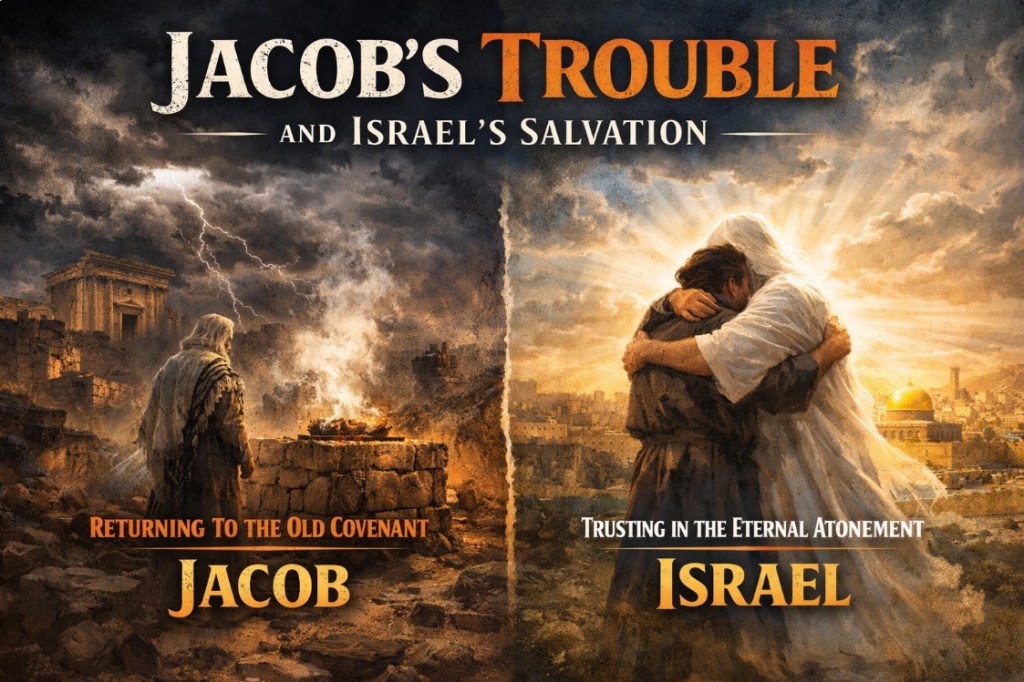
“Alas! for that day is great, so that none is like it: it is even the time of Jacob’s trouble; but he shall be saved out of it.”
— Jeremiah 30:7
If Israel is the covenant name God gave after Jacob wrestled with Him and prevailed, why does Scripture later refer to the nation by the older name Jacob—especially in connection with the final and greatest time of trouble?
The answer lies in how the Bible uses names. In Scripture, names often describe posture, not just identity.
Jacob and Israel: Two Names, Two Ways of Living
Jacob was the name that described how he lived before he was changed. He believed God’s promise, but he tried to secure it through deception, manipulation, and fear. He lied to gain the blessing, fled when confronted, and relied on strategy to survive. Jacob trusted the promise, but he did not fully trust the Provider.
Everything changed the night Jacob wrestled with God. When he could no longer run or maneuver, he clung to God and refused to let go. God wounded him, removing his self-reliance, and gave him a new name: Israel. Israel did not prevail by strength or strategy, but by holding on to God when there was nothing else to trust.
Yet Scripture does something important after this moment: it continues to use both names. Jacob is not erased. The text often refers to him as Jacob in moments of fear, grief, or self-preservation, and as Israel when God’s promises and purposes are in focus. The covenant remains the same, but the name reflects how he is functioning.
How the Nation Returns to “Jacob”
This same pattern explains why Jeremiah speaks of Jacob’s trouble.
Israel is not being renamed, and God is not revoking His promise. Instead, Scripture is describing a return to Jacob’s posture—a return to fear, self-reliance, and system-based security rather than dependence on God.
That return happens through what the Bible calls an old system.
Under the old covenant, atonement was managed through:
- repeated animal sacrifices
- continual offerings
- ritual systems that pointed forward but were never meant to be final
Those sacrifices were given by God for a time, but they were always temporary. According to the New Testament, God has now provided an everlasting atonement—one that does not need to be repeated and cannot be replaced.
Returning to the old covenant system after God has provided an everlasting atonement is not a step of faith. It is a step back into self-management.
It is Jacob again.
Why This Matters in the End Times
The deception of the last days is not merely political or military. Scripture warns of a deeper deception—one that does not openly reject God, but replaces trust in God’s finished work with a system that feels safer, more visible, and more controllable.
For Israel, that temptation is not paganism.
It is religion without reliance.
Those who return to the old covenant system are not denying God’s existence, but they are denying God’s sufficiency. They are choosing a mechanism over a promise, repetition over completion, and a substitute atonement over the everlasting one God has already provided.
That posture has a name in Scripture.
It is called Jacob.
“All Israel Will Be Saved” — What Scripture Means
“And so all Israel shall be saved: as it is written, There shall come out of Zion the Deliverer, and shall turn away ungodliness from Jacob.”
— Romans 11:26
Paul’s wording here is deliberate. He says all Israel will be saved, but he also says the Deliverer removes ungodliness from Jacob.
This tells us something crucial.
“All Israel” does not mean every ethnic Jew regardless of trust. Paul has already made clear that not all who are descended from Israel are Israel. Instead, Israel in its saved sense refers to those who live in dependence on God’s provision, not self-reliance.
In the end:
- Those who cling to the old system are functioning as Jacob
- Those who rely on God’s everlasting atonement are living as Israel
Salvation is the movement from Jacob back to Israel.
That is how all Israel is saved—not by returning to the old covenant, but by being delivered out of Jacob, as ungodliness is removed and trust is restored.
Why It Is Called Jacob’s Trouble
Jacob’s trouble is not about God abandoning His people. It is about God allowing the consequences of returning to an old way of operating. Just as Jacob himself had to be brought to the end of his strength before he could truly live as Israel, so the nation will be brought through a time that strips away self-reliance and exposes false security.
And yet, the promise remains:
“But he shall be saved out of it.”
The covenant does not fail.
The promise does not change.
But the name reflects the posture.
Jacob’s trouble is the crisis that reveals the difference—and through it, Israel is restored.
 asathief.com