
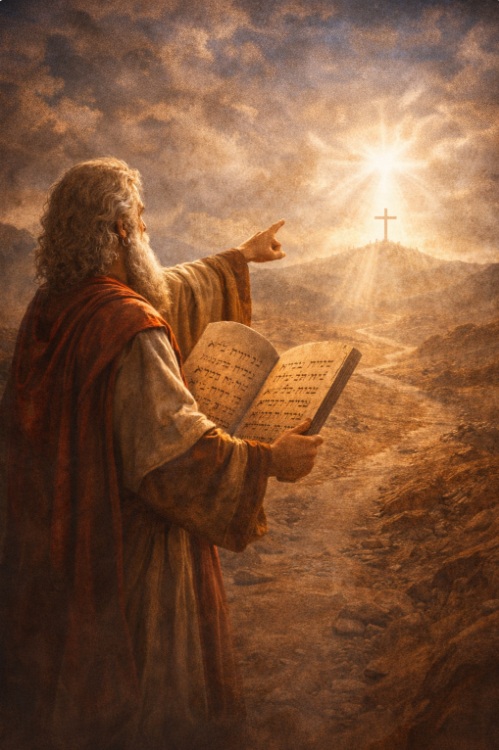
Many people around the world honor Moses. Jews read the Torah as sacred Scripture. Muslims affirm Moses as a true prophet sent by God. Others respect Moses as the foundation of faith in one God while rejecting the New Testament. This article is written for all who sincerely believe Moses spoke from God.
It does not ask you to abandon Moses.
It asks you to listen to him carefully.
Jesus once said something startling: if people truly believed Moses, they would believe Him as well. That statement is either deeply offensive—or deeply revealing. The only way to know which is to return to Moses himself and let his words speak without later assumptions placed on them.
What follows is not an argument from church tradition. It is a walk through what Moses actually wrote, and what those writings require if they are true.
What Moses Expected After Himself
Moses did not present himself as the final voice. He spoke of another who would come after him—one like him—whom the people must listen to. Moses knew what made him unique: he spoke with God directly, mediated between God and the people, delivered them from bondage, and stood in the breach when judgment fell. When Moses spoke of another like himself, he was not describing an ordinary prophet. He was pointing forward to someone greater.
Moses did not leave Israel waiting indefinitely. He left them watching.
What Moses Taught About Sin and Life
Moses established a truth that runs through the Torah: life is in the blood, and God gave blood upon the altar to make atonement for the soul. Sin was never treated lightly, and forgiveness was never granted cheaply. Covering required substitution. Death stood in place of the sinner.
At Passover, judgment passed over not because Israel was better than Egypt, but because blood marked the door. Deliverance did not come through obedience alone, but through what God Himself accepted.
Later, when the people were dying under judgment in the wilderness, Moses did not instruct them to improve themselves. He lifted up a bronze serpent, and those who looked in faith lived. Healing came not through effort, but through trust in what God provided.
Moses consistently taught that salvation moves from God to man, not from man to God.
For the One Rooted in the Torah
If you live within the Torah, Moses presents a Messiah who must do more than reign. He must deal with sin first. The altar, the sacrifices, the Day of Atonement, and the faith of Abraham all testify that restoration comes through atonement before glory.
Moses recorded that Abraham was counted righteous not by law, not by ritual, but by faith—before circumcision, before Sinai, before a nation even existed. He also recorded that through Abraham’s Seed, all nations would be blessed. The Torah itself reaches beyond one people and one land toward a global redemption.
If the Messiah only conquers but does not atone, the Torah remains unresolved.
For the One Who Honors Moses as a Prophet
Moses taught realities that are sometimes softened or denied later: substitution, blood atonement, mediation, and God drawing near to humanity. He did not present God as distant from His creation, but as holy and willing to dwell among His people—yet only through what He Himself provides.
Moses did not teach that sin is removed without cost. He taught that God bears the cost. He did not teach that righteousness is achieved through balance alone. He taught that righteousness comes from trusting God’s provision.
If Moses is true, then these patterns are not symbolic. They are intentional.
For All Who Believe Moses Spoke From God
Moses did not complete the story he began. He left a trail of expectation. A greater mediator. A deeper atonement. A blessing meant to reach beyond one nation to all nations. A fulfillment that would make sense of everything that came before.
Believing Moses does not mean stopping where he stopped.
It means continuing where he pointed.
Moses does not ask for blind allegiance. He asks for careful listening.
And if Moses is to be believed, then the question he leaves us with is not whether the story continues—but whether we are willing to follow where it leads.
 asathief.com