
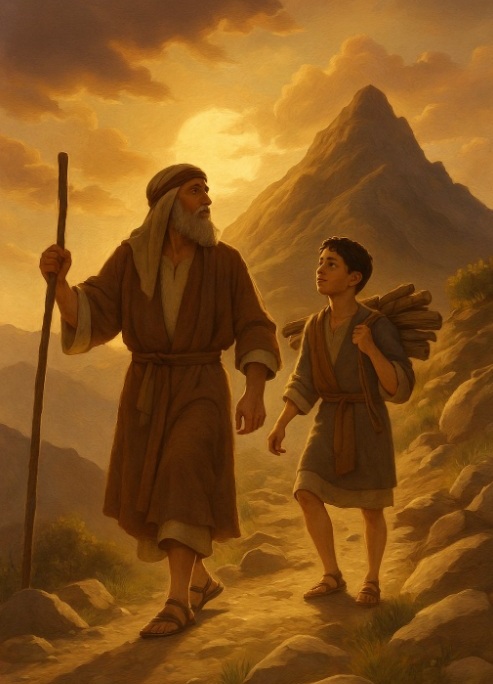
The Covenant Promise Misunderstood
“And I will bless them that bless thee, and curse him that curseth thee: and in thee shall all families of the earth be blessed.”
— Genesis 12:3
For generations, many have quoted God’s words to Abraham — “I will bless those who bless thee, and curse those who curse thee” — as if they were spoken to modern Israel. Yet this promise was not made to a political state, but to a man who believed God, and whose faith was counted unto him as righteousness. The covenant was personal, spiritual, and eternal — and its inheritance belongs to those who walk in that same faith: a faith willing to surrender everything, even the dearest thing, to God.
Abraham was willing by faith to give up his son — and in that act, God revealed His own heart. Because one man was willing to offer his son to God, God showed the world that there are people worth Him giving up His Son for. The cross was not just the fulfillment of prophecy; it was the reflection of a faith that began on Mount Moriah, when a father trusted that God could raise the dead.
The Covenant Belongs to Abraham and His Seed — Not the Flesh, But the Faithful
When God made His promise to Abraham, it wasn’t to a bloodline, but to a faith-line.
The Apostle Paul makes this clear:
“If ye be Christ’s, then are ye Abraham’s seed, and heirs according to the promise.” (Galatians 3:29)
The blessing was never meant to be inherited by mere descent, but by belief.
Jesus confronted this misunderstanding head-on. The Jews claimed, “We are Abraham’s children.” But Jesus replied, “If you were Abraham’s children, you would do the works of Abraham.” (John 8:39).
Lineage without likeness means nothing. The covenant family is not national, but spiritual — defined not by birth, but by rebirth.
The Two Jerusalems — Earthly and Heavenly
There is a Jerusalem that now is, and a Jerusalem that is above.
Paul said, “The Jerusalem which now is, is in bondage with her children; but Jerusalem which is above is free, which is the mother of us all.” (Galatians 4:25–26)
The earthly Jerusalem — ruled by religion, politics, and the traditions of men — has become polluted. Jesus Himself called her “the city that kills the prophets.”
Revelation later describes her as “the great city, spiritually called Sodom and Egypt.” She represents the fallen religious system — a mother of harlots, birthing counterfeit faiths that deny the Son.
But the heavenly Jerusalem, the New Jerusalem, is not built by hands. It descends from God — adorned as a bride for her husband (Revelation 21:2). She is the true dwelling place of righteousness, where the Lamb is the light and the throne of God is the center.
So when we speak of Jerusalem, we must discern which one. The old one still rejects the covenant; the new one is the covenant fulfilled.
Come Out of Her — But Do Not Rise Against Her
God is calling His people out of the polluted system —
“Come out of her, My people, that ye be not partakers of her sins, and that ye receive not of her plagues.” (Revelation 18:4)
We do not pray for that system to prosper; we pray for people to be delivered from it.
We desire for the children of Abraham to return to the faith of Abraham — not to the altar of beasts, but to the altar of the Lamb.
Yet at the same time, we must guard our hearts against the opposite error — the hatred that will soon fill the nations against Jerusalem.
Zechariah 14 prophesies that God Himself will gather all nations against Jerusalem to battle. But those same nations will be destroyed when the Lord returns to fight for His name’s sake.
The warning is twofold:
- Do not align your heart with her rebellion, lest you share in her plagues.
- Do not align your hand with her enemies, lest you share in their destruction.
To love truth is to walk the narrow road — separating from deception without becoming a destroyer.
The False Covenant vs. the True
In these last days, men speak of peace through the Abraham Accords, but the peace of man is not the covenant of God.
Abraham’s faith was not a treaty; it was obedience. He built altars, not alliances. He trusted God’s promise, not human agreements.
The true covenant of Abraham was confirmed in Christ — the promised Seed (Galatians 3:16).
Any covenant that rejects the blood of that Seed is a counterfeit peace preparing the world for judgment. It will seem to promise safety but will lead to sudden destruction (1 Thessalonians 5:3).
The Fig Tree’s Lesson
When Jesus cursed the fig tree, it wasn’t random. It was prophetic.
The tree had leaves — the appearance of life — but no fruit.
It represented a people with religion but no repentance, ceremony but no surrender.
That curse showed that outward Israel, like that tree, would wither until the time of the Gentiles was fulfilled.
Yet even now, the sap of mercy remains in the root. Some branches will yet be grafted back in — not through the law or a temple, but through faith in the same Messiah Abraham foresaw.
The rebirth of the fig tree in our generation is not a call to worship it, but a sign that the story is reaching its climax.
The Everlasting Blessing
Abraham believed, and it was counted to him as righteousness.
That is the root of the blessing.
The true heirs are not those who trace their lineage to his body, but those who trace their faith to his heart.
The promise has not failed — it has been fulfilled in the One who came through Abraham’s line — Yeshua HaMashiach, Jesus the Christ.
Those who are grafted in by faith become one family, one vine, one temple, and one people of God.
Through Yeshua, the everlasting covenant was sealed — not with the blood of goats, but with His own.
Through Him, the blessing of Abraham has reached every nation and every generation.
So let us love wisely.
Let us call people out of deception, but never let our hearts become the nations God will judge.
Because of the hardness of people’s hearts, God will use the nations against Jerusalem —
but in the end, as Zechariah 14:3 declares, He Himself will fight against those nations.
The story ends not with man’s vengeance, but with God’s victory — when the New Jerusalem descends,
and the promise spoken to Abraham is eternally fulfilled:
“In thee shall all families of the earth be blessed.”
Because of Abraham’s obedience, his faith did not waver.
He told his son, “God will provide Himself a lamb,” believing that if his son must die, God could raise him again.
He followed through up to the point where God intervened — and in that moment, the shadow of the cross took form.
What was foreshadowed on Moriah was fulfilled on Calvary — in Christ Jesus, the Lamb whom God Himself provided.
 asathief.com