
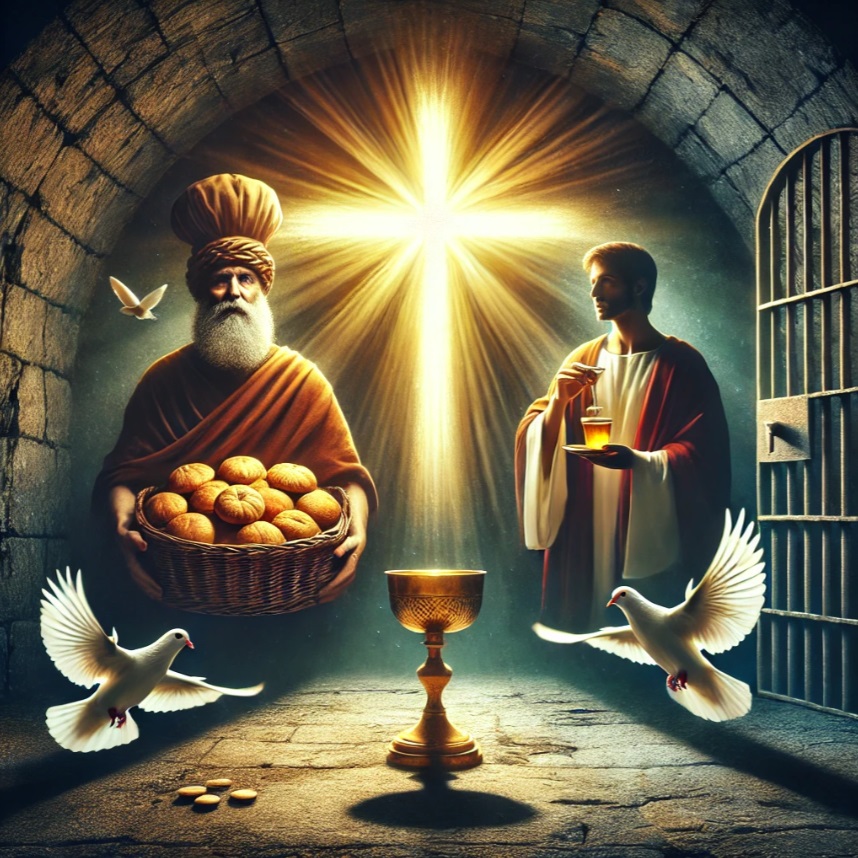
Throughout Scripture, God uses symbolic stories to foreshadow His ultimate plan of redemption. One such narrative is found in Genesis 40, where the fates of a baker and a cupbearer mirror the sacrifice of Jesus Christ and the freedom granted to believers through His blood. This account prophetically points to the bread and wine instituted by Jesus in the New Testament, representing His body and blood.
Jesus: The Bread and the Wine
On the night before His crucifixion, Jesus gave His disciples a lasting ordinance to remember His sacrifice:
“And as they did eat, Jesus took bread, and blessed, and brake it, and gave to them, and said, Take, eat: this is my body. And he took the cup, and when he had given thanks, he gave it to them: and they all drank of it. And he said unto them, This is my blood of the new testament, which is shed for many.” (Mark 14:22–24, KJV)
The bread symbolizes His body, broken for us, and the wine His blood, shed for the remission of sins. Jesus commanded His followers to observe this practice in remembrance of Him, linking it directly to His sacrificial death.
The Old Testament Parallel: The Baker and the Cupbearer
In Genesis 40, Joseph, imprisoned with Pharaoh’s chief baker and chief butler (cupbearer), interprets their dreams. These dreams provide a powerful picture of Christ’s death and the freedom available through His blood.
- The Baker’s Dream:”I also was in my dream, and, behold, I had three white baskets on my head: and in the uppermost basket there was of all manner of bakemeats for Pharaoh; and the birds did eat them out of the basket upon my head.” (Genesis 40:16–17, KJV)Joseph interprets this dream with solemn words:”Yet within three days shall Pharaoh lift up thy head from off thee, and shall hang thee on a tree; and the birds shall eat thy flesh from off thee.” (Genesis 40:19, KJV)
- The Cupbearer’s Dream:”And Pharaoh’s cup was in my hand: and I took the grapes, and pressed them into Pharaoh’s cup, and I gave the cup into Pharaoh’s hand.” (Genesis 40:11, KJV)Joseph explains:”Yet within three days shall Pharaoh lift up thine head, and restore thee unto thy place: and thou shalt deliver Pharaoh’s cup into his hand, after the former manner when thou wast his butler.” (Genesis 40:13, KJV)
Three days later, these events unfold exactly as Joseph had interpreted: the baker is executed, and the cupbearer is restored.
Prophetic Connections to the Cross
The story of the baker and the cupbearer foreshadows key aspects of Christ’s sacrifice and the redemption it brings.
1. The Baker’s Death and the Bread
The baker’s death represents Jesus, the Bread of Life, who was “hung on a tree” for the sins of humanity.
“Christ hath redeemed us from the curse of the law, being made a curse for us: for it is written, Cursed is every one that hangeth on a tree.” (Galatians 3:13, KJV)
The bread in the baker’s dream symbolizes the body of Christ, broken and offered for the salvation of mankind.
“And he took bread, and gave thanks, and brake it, and gave unto them, saying, This is my body which is given for you: this do in remembrance of me.” (Luke 22:19, KJV)
2. The Cupbearer’s Restoration and the Wine
The cupbearer’s release and restoration symbolize the freedom and life offered through the blood of Christ. The wine he pressed represents the blood of the New Covenant.
“In whom we have redemption through his blood, the forgiveness of sins, according to the riches of his grace.” (Ephesians 1:7, KJV)
The blood of Jesus not only frees us from sin but also restores our relationship with God.
“If the Son therefore shall make you free, ye shall be free indeed.” (John 8:36, KJV)
3. The Three Days
Both the baker and the cupbearer’s destinies were fulfilled after three days, pointing to the resurrection of Jesus on the third day. His resurrection is the ultimate confirmation of our freedom and redemption.
“And that he was buried, and that he rose again the third day according to the scriptures.” (1 Corinthians 15:4, KJV)
Bread and Wine Fulfilled
When Jesus introduced the bread and wine at the Last Supper, He connected His impending sacrifice to a deeper spiritual truth. The bread represents His body, broken like the baker’s fate, while the wine represents His blood, poured out to set us free like the cupbearer.
“For as often as ye eat this bread, and drink this cup, ye do shew the Lord’s death till he come.” (1 Corinthians 11:26, KJV)
Conclusion: A Call to Remember
The story of the baker and the cupbearer is a powerful Old Testament prophecy pointing to the sacrifice of Jesus Christ. The baker’s death mirrors the offering of Jesus’ body on the cross, while the cupbearer’s release highlights the freedom and restoration made possible by His blood.
As believers, we are called to remember this profound truth each time we partake in the Lord’s Supper:
“And when he had given thanks, he brake it, and said, Take, eat: this is my body, which is broken for you: this do in remembrance of me. After the same manner also he took the cup, when he had supped, saying, This cup is the new testament in my blood: this do ye, as oft as ye drink it, in remembrance of me.” (1 Corinthians 11:24–25, KJV)
Let us approach the bread and the wine with gratitude, proclaiming the death of our Savior until He comes again. Through His body and blood, we are set free, restored, and made whole.
 asathief.com