
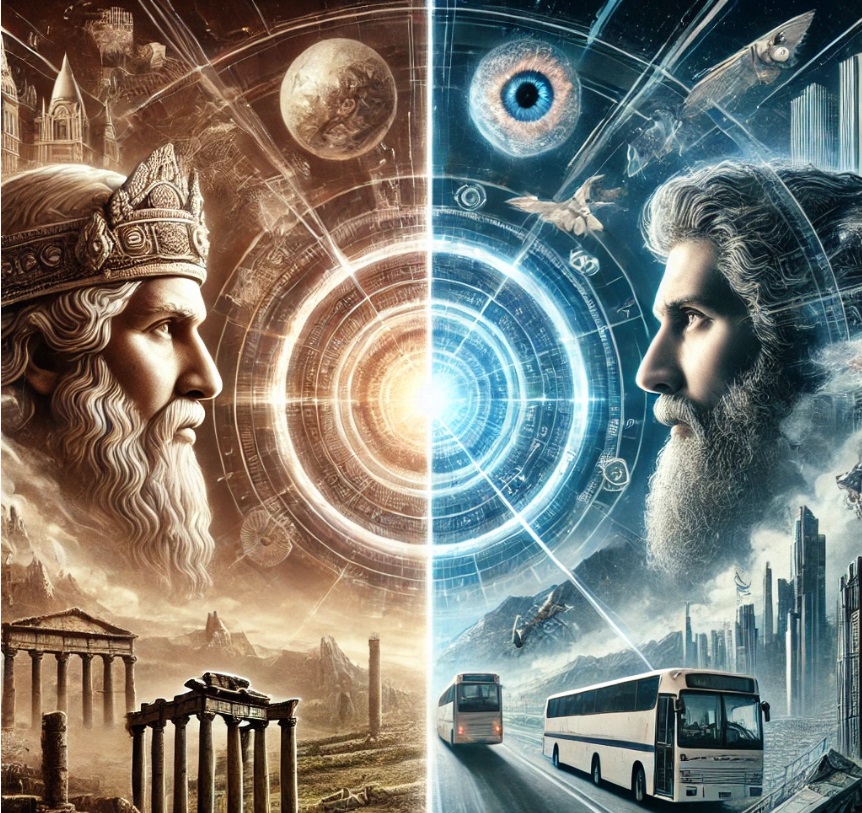
The Bible’s prophetic books of Daniel and Revelation are deeply interconnected, presenting powerful images of kingdoms, beasts, and divine judgments. Both Daniel and John (the author of Revelation) saw visions of future empires and the culmination of God’s plan. However, their perspectives are unique—Daniel, looking forward in time, saw a series of empires yet to come, while John, taken into the future, looked back at these same empires. This distinction explains the apparent reversal in the order of the beasts between the two prophets.
Daniel’s Vision: Looking Forward to the Kingdoms
In the book of Daniel, the prophet describes his vision of four beasts representing four successive empires that would rise to power:
“The first was like a lion, and had eagle’s wings: I beheld till the wings thereof were plucked, and it was lifted up from the earth, and made stand upon the feet as a man, and a man’s heart was given to it. And behold another beast, a second, like to a bear, and it raised up itself on one side, and it had three ribs in the mouth of it between the teeth of it: and they said thus unto it, Arise, devour much flesh. After this I beheld, and lo another, like a leopard, which had upon the back of it four wings of a fowl; the beast had also four heads; and dominion was given to it. After this I saw in the night visions, and behold a fourth beast, dreadful and terrible, and strong exceedingly; and it had great iron teeth: it devoured and brake in pieces, and stamped the residue with the feet of it.” (Daniel 7:4-7, KJV)
The order of these beasts is significant because it represents a prophetic timeline:
- Lion with eagle’s wings – This beast is traditionally understood to represent the Babylonian Empire.
- Bear raised on one side – This is often interpreted as the Medo-Persian Empire.
- Leopard with four wings – This represents the Greek Empire, which under Alexander the Great, swiftly conquered much of the known world.
- Terrifying beast with ten horns – This final beast is usually associated with the Roman Empire and its legacy, which many believe will culminate in a future coalition of powers.
Daniel was looking forward, from his time, toward these empires that were yet to come. His vision unfolds progressively, leading to the rise of these kingdoms one after another, culminating in a final, terrifying empire.
John’s Vision in Revelation: Looking Back From the Future
In Revelation, John saw a similar vision of a beast, but with a key difference. This beast combines the elements of the four animals that Daniel saw, but the order is reversed:
“And the beast which I saw was like unto a leopard, and his feet were as the feet of a bear, and his mouth as the mouth of a lion: and the dragon gave him his power, and his seat, and great authority.” (Revelation 13:2, KJV)
Notice the order: leopard, bear, and lion—the complete reverse of what Daniel saw. Rather than seeing four distinct beasts as Daniel did, John saw one composite beast that represented all the prior empires in a single, terrifying figure.
John’s vision takes place in the context of the end times, after the rise and fall of these historical empires. He was taken forward in time, witnessing the culmination of world history from a vantage point at the end of the age. From his perspective, he looked back at the same empires Daniel saw, but as a unified whole.
Where Daniel was looking forward to a series of kingdoms that would emerge on the world stage, John, standing in the future, saw their completion—a single beast that represents the full sum of the powers that have opposed God’s kingdom throughout history. This reversal in perspective explains the inverted order of the animals.
Why the Opposite Order?
The differing orders in the visions of Daniel and John highlight a profound prophetic truth: perspective matters. Daniel, living in Babylon, was looking forward in time, anticipating the rise of successive empires that would eventually lead to the final, fearsome kingdom symbolized by the beast with ten horns. The order in Daniel’s vision reflects how these empires would emerge one after the other.
John, on the other hand, was taken into the future, and from that vantage point, he looked back at the history of these kingdoms. From his perspective, they had already come and gone, but their spirit and essence were embodied in a single end-time power, symbolized by the composite beast. The reverse order in John’s vision reveals that he is now seeing the full culmination of these powers in their final form.
This also reflects a theological truth: God’s view of history is complete. The seeming chaos of the rise and fall of earthly kingdoms is, in fact, part of a divine plan that will one day be fulfilled. John saw the end of this process, where all the empires that opposed God’s rule are united under the final, antichrist system, empowered by the dragon (Satan). From John’s perspective, history was moving toward its ultimate climax in the establishment of God’s eternal kingdom.
The Significance of the Unified Beast in Revelation
The composite beast that John saw in Revelation 13 reveals a crucial detail about the end times: the final kingdom that will oppose God’s people is not just a new political power but the culmination of all previous ungodly empires. It inherits the characteristics of Babylon, Persia, Greece, and Rome. The antichrist system is the final expression of all the powers that have warred against God’s people throughout history.
While Daniel saw these empires rising one after the other in succession, John’s vision shows that in the end times, these powers merge into one final oppressive system that dominates the world. The beast has the swift aggression of the leopard (Greece), the strength and tenacity of the bear (Persia), and the regal authority of the lion (Babylon). It is empowered by Satan himself to wage war against the saints and to deceive the nations.
Conclusion: Two Prophets, One Message
Daniel and John, though separated by centuries, both saw the unfolding of God’s prophetic plan. Daniel, standing in the past, looked forward to the rise of empires that would dominate the world stage. John, transported into the future, looked back and saw the sum of these empires embodied in a final, terrifying beast.
This reversal in the order of the beasts is not a contradiction but a reflection of the different vantage points from which the two prophets viewed history. Where Daniel saw the future from his time, John was given the privilege to see history from the perspective of the end. Together, their visions give us a complete picture of how God’s plan for the nations will unfold, culminating in the defeat of the beast and the establishment of God’s eternal kingdom.
In both visions, the message is clear: earthly powers will rise and fall, but God’s Kingdom will endure forever. And while the final kingdom may seem overwhelmingly powerful, Revelation assures us that the beast will ultimately be defeated, and the Lamb will reign victorious.
 asathief.com